Last updated 2026-08-17
TL;DR
Alaska has no single statewide cattery license. Renewal happens at two levels: your local municipality (an annual animal facility permit) and USDA APHIS if you ship kittens across state lines. Federal fees run $30 to $750 a year by sales volume. Local permits in Anchorage historically run $100 to $300. Fees and timelines vary by borough, so confirm current figures locally.
Do you need a license for a cattery in Alaska?
Yes, but not from the state. Alaska keeps no standalone statewide cattery or pet breeder license the way many states do. What you face instead is a layered system, and the layers depend entirely on what your cattery does.
Breed cats and sell them across state lines, or sell to research facilities, and you need a USDA Animal Welfare Act Class A (breeder) or Class B (dealer) license from APHIS. The AWA defines a dealer as a person who sells animals in commerce, and the trigger for a federal license is more than four breeding females of any regulated species if you sell to unregulated buyers [1]. Cats are regulated animals under the AWA.
Run a boarding cattery, taking in cats owned by others for pay, and you generally fall under local municipality rules instead of a state license. Anchorage, Fairbanks, Juneau, and the Matanuska-Susitna Borough each run their own animal control and licensing structures. A boarding operation in Anchorage has to comply with Anchorage Municipal Code Chapter 17.45, which governs animal shelters and commercial animal establishments [2]. That permit is renewed annually.
Here is the Alaska confusion point. Because the legislature never passed a dedicated cattery or pet dealer statute, people assume no license is needed at all. That assumption gets catteries shut down. The obligation lives at the borough level even when the state stays silent, so check with your specific municipality.
What Alaska agencies and offices handle cattery licensing and renewal?
Three sources of authority can touch a cattery in Alaska. Most operators deal with two of them.
First, USDA APHIS Animal Care. This is the federal layer. Hit the threshold for a Class A or Class B dealer license and you apply through the APHIS licensing system, then renew annually [1]. APHIS Animal Care's Western Region office covers Alaska, and you reach them through the APHIS Animal Care licensing portal at aphis.usda.gov.
Second, your municipality or borough. This is where most small Alaska operators spend their renewal time. Anchorage Animal Care and Control issues permits for commercial animal establishments. Fairbanks North Star Borough runs its own animal control office. Operate outside an organized borough and the rules thin out, though the Alaska Department of Environmental Conservation can apply waste and environmental standards that indirectly reach facility operations [3].
Third, the Alaska Department of Fish and Game. This one applies only if your cattery involves hybrid cats or any breed with a wildlife classification. A Bengal crossed with an Asian Leopard Cat at certain filial generations may require ADF&G documentation [4]. Niche, but Alaska-specific and worth knowing.
For most cattery operators here, renewal is a two-stop trip: your local municipality, and APHIS if you ship kittens out of state.
How much does a cattery license or permit cost in Alaska?
Nobody keeps clean centralized data on this for Alaska, because costs vary by municipality and change on separate budget cycles. Here is what is publicly documented or reasonably estimable.
USDA APHIS Class A (breeder) license fees are set federally. Under the current APHIS fee schedule, annual license fees run from $30 for operations with gross sales under $500 up to $750 for larger-volume operations [1]. Most small catteries sit in the bottom tiers.
| Operation type | Approximate annual federal fee |
|---|---|
| Class A, gross sales under $500 | $30 |
| Class A, gross sales $500-$2,000 | $60 |
| Class A, gross sales $2,001-$10,000 | $120 |
| Class A, gross sales over $10,000 | $750 |
Source: USDA APHIS, Animal Welfare Act License Fees [1]
At the local level, Anchorage's commercial animal establishment permit has historically run $100 to $300 a year depending on how many animals you house. Confirm the current figure with Anchorage Animal Care and Control directly, because the municipal fee schedule moves with the annual budget [2]. Fairbanks North Star Borough follows a similar structure on its own schedule.
Beyond the permit fee, budget for inspection-driven costs. Facilities need to pass an initial and sometimes annual inspection, so any remediation work comes out of your pocket before renewal is granted. A small home cattery might spend $0 on upgrades. A larger boarding facility could see plumbing, ventilation, or cage-spacing fixes run into the thousands.
Total first-year cost for a modest Alaska breeding cattery, meaning the APHIS license plus a local permit with no major facility work, lands somewhere between $130 and $600 depending on sales volume and municipality. That estimate leaves out zoning, business registration, and veterinary health certificate costs.
How long does cattery licensing and renewal take in Alaska?
Two separate clocks run here: federal and local. Watch both.
USDA APHIS licensing for a new applicant takes 60 to 90 days from a completed application to license issuance, based on APHIS's stated timelines [1]. That window includes the pre-license inspection, which APHIS schedules after reviewing your application. Renewal of an existing APHIS license moves faster, usually 30 days or less when submitted on time, because no new inspection is required unless your operation changed significantly.
Local timelines vary. Anchorage's animal control office has historically processed commercial establishment permit renewals within two to four weeks when paperwork is complete and no inspection deficiencies exist [2]. Flag an issue at inspection and the clock pauses until you fix it and request re-inspection.
Do not wait until your current license expires to start. APHIS ties renewal deadlines to your original license anniversary date. Miss that date by a single day and you are technically out of compliance. Submit 60 days ahead for a first-time renewal; 30 days works if you have a clean prior inspection record.
For local permits in Alaska, 45 days before expiration is a safe buffer. Smaller boroughs run thin animal control staff, and scheduling an inspection in rural Alaska can add weeks.
What does the cattery renewal process actually look like step by step?
Here is the realistic sequence for an Alaska cattery operator doing an annual renewal.
Step one: confirm your renewal window. For APHIS, log in to the online licensing system and check your anniversary date. For your local permit, read the expiration date off the physical permit; Anchorage and most boroughs issue paper permits with a printed expiration.
Step two: review what changed since last renewal. Added animals, changed facility square footage, changed business structure, all of it has to be disclosed. APHIS requires amended applications for material changes [1]. Municipalities carry similar change-of-use provisions.
Step three: complete the renewal paperwork. APHIS renewal runs online through the APHIS Animal Care Licensing and Registration portal. Local permits usually use a paper or PDF form submitted to the municipal animal control office.
Step four: pay renewal fees. APHIS takes payment online. Municipalities vary; Anchorage accepts checks and some online payments depending on the current system.
Step five: wait for inspection or confirmation. APHIS may or may not schedule a routine inspection in a renewal year, depending on your compliance history. Local inspections are more common at renewal for commercial establishments in Anchorage.
Step six: receive your renewed license. APHIS emails or mails the updated license. Post it where it is visible at your facility, because that is an AWA requirement [1].
Want the USDA and Alaska-specific renewal documents in one place? CatteryPath's $149 one-time kit at /start includes the current federal forms and a state-by-state agency contact list, which helps when you are tracking two renewal clocks at once.
What happens if you miss the cattery renewal deadline in Alaska?
Missing your USDA APHIS renewal deadline is not a grace-period situation. Operating without a current AWA license is a federal violation, and it can draw fines up to $10,000 per violation per day under the AWA [5]. In practice, APHIS often issues a warning for a first lapse if you self-report and renew quickly, but the agency keeps discretion to fine.
Local penalties vary by municipality. Anchorage can issue citations and, for repeat violations, revoke a commercial animal establishment permit. Running a commercial cattery without a valid local permit also opens you to zoning enforcement.
There is a quieter problem too. Register your cattery with TICA or CFA and those organizations may ask for proof of applicable government licensing. A lapsed license can hit your standing and your ability to register litters.
Set a calendar reminder 90 days before every expiration date. That is enough lead time to absorb any inspection surprise without going dark.
Do Alaska hybrid cat regulations affect cattery licensing?
Potentially, yes. The Alaska Department of Fish and Game regulates possession of exotic animals, and some hybrid cat breeds sit in a gray zone depending on filial generation [4]. ADF&G's rules under AS 16.05.920 and 5 AAC 92.029 address prohibited species and hybrid possession.
Here is the practical concern. Breed or board Bengals (ALC hybrids) or Savannahs (serval hybrids) and you need to confirm with ADF&G whether your specific generation requires a state permit. Early-generation cats (F1 through F3) are the ones most likely to trigger review. Fully domestic Bengals at F4 and beyond are generally treated as domestic cats.
Most national cattery resources miss this wrinkle entirely. A cattery in Texas or California faces different hybrid rules. Alaska's geography and wildlife management posture make ADF&G more protective of native species interactions, so the state scrutinizes hybrid possession harder than many lower-48 states.
Work with any hybrid breed and get written confirmation from ADF&G before your next renewal cycle. That confirmation becomes documentation you keep on file.
How does Alaska compare to nearby states for cattery licensing requirements?
Alaska is lighter than most contiguous states at the state level. That does not make the total burden lighter, because the federal APHIS layer applies the same everywhere.
Idaho, for example, runs a state animal dealer and breeder licensing system through the Idaho State Department of Agriculture, so Idaho operators juggle three layers: APHIS, state, and local [6]. See how that plays out at cattery renewal in Idaho.
California carries the most aggressive state-level breeder oversight, including AB 1230 rules affecting retail pet sales and breeder disclosure [7]. Cattery renewal in California is its own animal. Alaska looks simple next to it.
Colorado added breeder licensing under its Pet Animal Care Facilities Act, a state layer much like Idaho's [8]. Cattery renewal in Colorado reflects that.
Florida's Division of Animal Industry licenses pet dealers, so a Florida operator selling kittens carries a state obligation Alaska operators skip. See cattery renewal in Florida for that path.
The honest summary: Alaska's missing state cattery license is unusual but not one of a kind. Your compliance burden is municipality-dependent, which is actually harder to research than a clean state system, because every borough writes its own rules.
What facility standards must an Alaska cattery meet for renewal inspections?
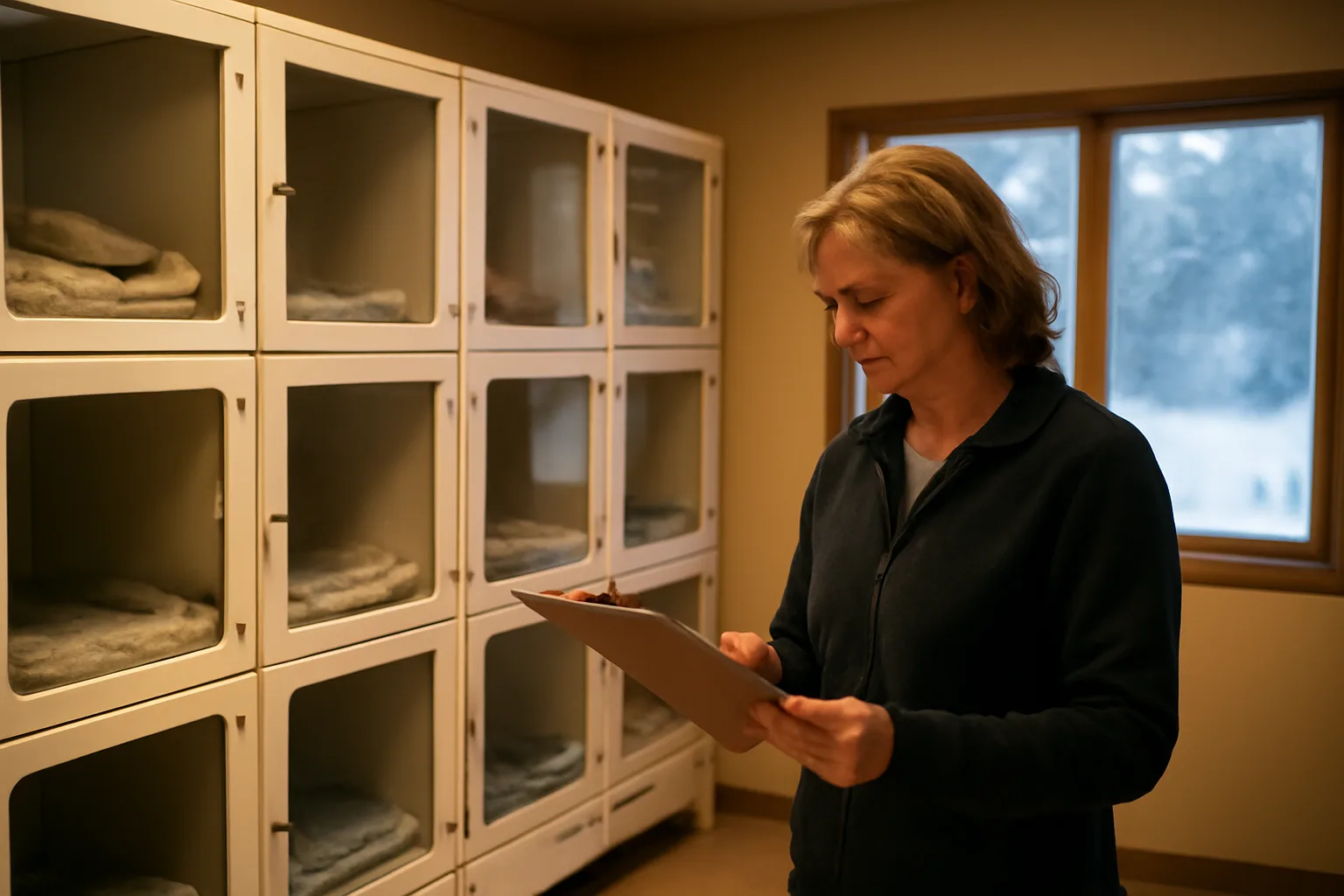
Hold a USDA APHIS license and the AWA's cat standards live in 9 CFR Part 3, Subpart A [9]. The core renewal requirements: primary enclosures give at least 3 square feet of floor space per cat plus 1 additional square foot for each additional cat housed together; environmental temperature stays between 50 and 85 degrees Fahrenheit; fresh water is available at all times; and the facility is cleaned and disinfected on a documented schedule [9].
Cold is the Alaska issue. That 50 degree floor is a federal minimum. Run a cattery in an unheated outbuilding in interior Alaska in January and it will not pass inspection. Heating an APHIS-compliant facility in Fairbanks or on the Kenai Peninsula is a real operating cost you have to budget.
Locally, Anchorage's commercial animal establishment standards cover sanitation, noise, and waste disposal under municipal code [2]. These parallel the AWA standards in many spots but get enforced independently. One inspection might check both if an Anchorage Animal Care inspector shows up alongside an APHIS inspector, but do not count on that coordination.
Document everything. Inspection logs. Cleaning schedules. Veterinary visit records. Temperature logs. An inspector reviewing a renewal wants proof your facility runs the same way between visits as it does the day they walk in.
What about business registration and zoning for a cattery in Alaska?
A cattery is a business, and any business operating in Alaska registers with the Alaska Division of Corporations, Business and Professional Licensing under DCCED [10]. This is separate from the cattery permit. Operate as a sole proprietor under your own name and the registration is simpler; use a business name and you file a DBA. LLCs and corporations file formation documents through the same DCCED portal.
Zoning matters more than most new operators expect. Running a cattery, especially a boarding cattery with multiple cats and client traffic, reads as a commercial or agricultural use in most zoning schemes. In Anchorage, Municipal Code Title 21 (Land Use Regulation) governs what uses are permitted in each zone [11]. A home-based cattery in a residential zone may qualify as a home occupation, but that classification usually caps the number of animals, bars employees, and limits signage and client visits.
In rural Alaska and unorganized boroughs, zoning is either absent or handled differently, which can work in your favor if you have acreage. It also means you have less legal cover if a neighbor complains.
Sort out zoning before you spend on facility upgrades. A permit application that triggers a zoning review after you have already built cat enclosures is a painful place to be.
Similar zoning-first advice holds in states like Alabama and Georgia, where local land use rules shape what the cattery permit process even looks like.
Practical tips for keeping your Alaska cattery renewal on track
Track two separate expiration dates: your APHIS license (if it applies) and your local municipality permit. They almost certainly do not share an anniversary.
Keep a physical renewal file with copies of every prior license, every inspection report, and every fee receipt. APHIS has had licensing system delays before; your paper records are the backup.
Build a relationship with the inspector assigned to your facility. In Alaska, where animal control staff runs thin, the same person may inspect you year after year. They notice when you are on top of things.
Ship kittens outside Alaska and you need to understand the destination state's import requirements. Some states require a Certificate of Veterinary Inspection (health certificate) within a set window before shipment. Hawaii, for one, holds very strict animal import rules [12]. The CatteryPath kit at /start includes destination-state import summaries alongside the federal renewal documents, which matters when your buyers are scattered across the country.
Budget every year for the chance of minor facility upgrades at inspection time. Even well-run facilities catch a note about a worn enclosure latch or a drainage issue. Keeping $300 to $500 in a renewal contingency saves you the scramble.
Sign up for APHIS email notifications through the Animal Care portal. They send renewal reminders, and those reminders are the simplest way to avoid a lapse.
Frequently asked questions
Do you need a license for a cattery in Alaska?
Alaska has no standalone statewide cattery license. You need a local commercial animal establishment permit from your municipality (such as Anchorage Animal Care and Control) and, if you sell kittens across state lines, a USDA APHIS Class A breeder license. The USDA threshold is more than four breeding females with sales to unregulated persons. Confirm local requirements with your specific borough.
How much does a cattery cost in Alaska?
Federal APHIS license fees run $30 to $750 a year depending on gross sales volume. Local municipality permits in places like Anchorage have historically ranged from roughly $100 to $300 annually, but fees change with municipal budgets so confirm the current figure with your local animal control office. Total first-year cost for a small operation is typically between $130 and $600, excluding facility upgrades or zoning costs.
How long does cattery licensing take in Alaska?
USDA APHIS initial licensing takes 60 to 90 days from a complete application, including the pre-license inspection. APHIS renewal for existing licensees typically processes in 30 days or less when submitted on time. Local municipality permit renewals in Anchorage historically process within two to four weeks when paperwork is complete and no inspection deficiencies exist. Submit renewals 45 to 60 days before expiration to stay safe.
Which agency inspects Alaska catteries?
USDA APHIS Animal Care inspects federal licensees; its Western Region covers Alaska. Your local municipality's animal control office handles inspections for the local commercial establishment permit. These are two separate inspections by two separate agencies. Alaska Department of Fish and Game may be involved if you work with hybrid cat breeds subject to state exotic animal regulations.
Does Alaska require a license to board cats for pay?
There is no statewide boarding license in Alaska. Boarding cattery operators in organized municipalities like Anchorage must hold a commercial animal establishment permit under local code. In unorganized boroughs, the requirement may be absent or minimal. Always check with your specific local authority before opening or continuing operations, because operating without a required local permit is an enforceable violation.
What happens if my Alaska cattery license lapses?
A lapsed USDA APHIS license puts you in federal violation of the Animal Welfare Act, with potential fines up to $10,000 per violation per day, though first-time lapses with prompt self-correction typically result in a warning. A lapsed local permit can mean citations and, for repeat issues, permit revocation. Set a 90-day pre-expiration reminder and do not rely on receiving a renewal notice in the mail.
Are hybrid cats like Bengals or Savannahs regulated differently in Alaska?
Yes. Alaska Department of Fish and Game regulates hybrid cat possession under AS 16.05.920 and 5 AAC 92.029. Early-generation hybrids (F1-F3 Bengals, F1-F3 Savannahs) are most likely to require state review. Fully domestic generations (F4 and beyond for Bengals) are generally treated as domestic cats. Get written confirmation from ADF&G if you breed or board any hybrid breed to protect your renewal documentation.
Does my Alaska cattery need a veterinarian of record?
USDA APHIS regulations require licensed facilities to have a program of veterinary care that includes a designated attending veterinarian with appropriate authority, documented in writing. This is a federal requirement for APHIS licensees, not a separate Alaska state rule. Local municipal permits may also require documentation of veterinary care. Having a named attending vet is effectively required for any licensed cattery operation.
What space requirements apply to Alaska cattery enclosures?
Federal AWA standards under 9 CFR Part 3 require at least 3 square feet of floor space per cat, plus 1 additional square foot for each additional cat housed together in a shared enclosure. Alaska's cold climate also requires meeting the AWA's environmental temperature standard of 50 to 85 degrees Fahrenheit, which is a real operational challenge for unheated outbuildings in interior Alaska winters. Document your temperature logs.
Do I need to register my cattery as a business in Alaska?
Yes. Any cattery operating as a business in Alaska must register with the Alaska Division of Corporations, Business and Professional Licensing under the Department of Commerce, Community, and Economic Development. Sole proprietors using their own name have a simpler process; those using a business name file a DBA. This registration is separate from and in addition to any cattery or animal facility permit.
How does Alaska cattery licensing compare to other states?
Alaska is unusual in having no statewide cattery or pet breeder license; most states with active agriculture departments add a state layer on top of the federal APHIS requirement. States like California, Colorado, Florida, and Idaho all have state-level pet dealer or breeder licensing that Alaska lacks. Alaska's compliance burden is lower at the state level but more variable locally because each municipality sets its own rules.
Can I run a cattery from home in Alaska?
Possibly, depending on your municipality's zoning rules. In Anchorage, a home-based cattery may qualify as a home occupation under Title 21, but that status typically limits animal counts, prohibits outside employees, and restricts client traffic. In rural Alaska and unorganized boroughs, home-based operations face fewer formal zoning restrictions. Confirm your zoning classification before operating, because a zoning violation can block permit renewal.
What records does an Alaska cattery need to keep for renewal?
APHIS-licensed facilities must maintain acquisition and disposition records for each animal, an attending veterinarian program of care document, cleaning and sanitation logs, and inspection reports. Records must be kept for at least three years and made available to inspectors on request. Local municipality permits may require similar sanitation and vaccination records. Keeping a unified facility binder makes both federal and local inspections significantly smoother.
Where do I actually apply for cattery renewal in Alaska?
For your USDA APHIS license: the APHIS Animal Care online licensing portal at aphis.usda.gov. For your local permit: contact your municipality directly. In Anchorage, that is Anchorage Animal Care and Control. In Fairbanks, it is the Fairbanks North Star Borough Animal Control. In the Mat-Su Borough, it is their animal control office. There is no single statewide renewal portal; you work two systems independently.
Sources
- Anchorage Municipal Code, Title 17 (Animals), Chapter 17.45: Anchorage commercial animal establishment permit requirements and annual renewal obligation
- Alaska Department of Environmental Conservation, Solid Waste Management Program: DEC environmental and waste disposal standards that apply to animal facilities in Alaska
- Idaho State Department of Agriculture, Animal Industries Division: Idaho maintains a state animal dealer and breeder licensing system separate from APHIS
- California Health and Safety Code Section 122354.5 (AB 1230, Pet Rescue and Adoption Act): California AB 1230 requirements affecting retail pet sales and breeder disclosure obligations
- Colorado Department of Agriculture, Pet Animal Care Facilities Act (2 CCR 406-16): Colorado's Pet Animal Care Facilities Act requires state-level breeder and boarding facility licensing
- Code of Federal Regulations, 9 CFR Part 3 Subpart A, Standards for Dogs and Cats: AWA facility standards for cats: 3 sq ft minimum per cat, 50-85°F temperature range, fresh water, sanitation documentation
- Alaska Division of Corporations, Business and Professional Licensing, DCCED: Alaska business registration requirement for cattery operations through DCCED
- Anchorage Municipal Code, Title 21 (Land Use Regulation): Anchorage zoning rules governing home occupation and commercial animal establishment land use classifications
- Hawaii Department of Agriculture, Animal Industry Division, Animal Import Requirements: Hawaii strict animal import rules relevant to Alaska cattery operators shipping kittens to Hawaii buyers