Last updated 2026-08-18
TL;DR
A Connecticut cattery needs a $100 annual state kennel license from the Department of Agriculture. Some towns add $25 to $50. A USDA Class A breeder license (base $120 plus revenue tiers) applies if you sell cats sight unseen. Startup runs $5,000 to $20,000; monthly care runs $400 to $800. Full licensing takes 4 to 8 weeks from a complete application.
How much does a cattery cost in Connecticut?
Costs come in three layers: licenses, one-time startup, and ongoing care. Licensing runs about $270 per year ($100 state, $120 federal USDA if you ship, plus local fees). Startup infrastructure and equipment for a small home cattery usually falls between $5,000 and $20,000, not counting the breeding cats. Then you are looking at $400 to $800 each month for food, litter, vet care, and utilities.
Put it together and a solid first-year budget lands between $15,000 and $35,000, depending on scale and how much you do yourself. These numbers come from actual state fees, USDA fee tables, and national pet spending data, scaled for a multi-cat operation. I break each category down below so you can build a budget that fits your plan.
Do you need a license for a cattery in Connecticut?
Yes. Anyone owning or operating a kennel of cats kept for breeding must hold a state kennel license from the Department of Agriculture. The law is clear. Connecticut General Statutes Section 22-344 defines a "kennel" as one pack or collection of dogs or cats on a single premises for breeding, show, competition, or mercantile purposes [1]. If you raise kittens to sell, you meet that definition.
There is no hobby breeder exemption in the statute. The Department of Agriculture's Animal Breeder and Kennel Program enforces it [2]. You apply, pay the fee, and pass an inspection before you can legally breed and sell.
A federal license enters the picture when you sell cats sight unseen, online, through a broker, or to a pet store. The Animal Welfare Act requires a USDA Class A breeder license for those sales. Face-to-face retail sales from your own premises are exempt [3]. Many Connecticut breeders still get the USDA license upfront to keep the option of shipping or selling to an out-of-state buyer.
Your town may have its own kennel license too. State law Section 22-342 lets towns license and set fees for kennels [4]. The town clerk is your first stop. Skip a local license and you can face fines or an order to stop operating, even with valid state paperwork.
How much does a cattery license cost in Connecticut?
The state kennel license costs $100 per year. No separate application fee applies; that $100 covers it. You renew annually. The Department of Agriculture sets this fee and confirms it on its public licensing page [2].
If you pursue USDA licensing, the Animal and Plant Health Inspection Service (APHIS) charges a $10 application fee. The annual license fee then depends on your gross sales. For sales up to $500, the fee is $120; for $501 to $2,000, it is $215 [5]. Most small home catteries stay in the lowest bracket.
Town fees vary. Some charge nothing. Some charge $25, some $100. The Town of Farmington lists a kennel license fee of $25 for up to 10 animals [6]. West Hartford's clerk charges $50 for a kennel license [7]. Plan on $50 as a safe placeholder and confirm with your own town. So the typical annual licensing tab for a Connecticut cattery (state, USDA, and local) lands around $270.
How long does it take to get a cattery license in Connecticut?
Once the Department of Agriculture receives your completed application and $100 fee, it takes about 2 to 3 weeks to assign an inspector. The inspector calls to set a date, often within 1 to 2 weeks. The on-site visit checks housing, sanitation, and recordkeeping readiness. Pass, and the license mails out in another 1 to 2 weeks.
The DOAG program aims to finish the full process within 30 days of a complete application [2]. In practice, expect 4 to 8 weeks from the day you mail the form. Delays happen if the inspector finds a deficiency that needs a follow-up visit or if your paperwork is incomplete.
USDA licensing runs its own clock. APHIS processes applications in 4 to 6 weeks from receipt of the $10 fee and a complete packet [5]. You can submit both state and federal paperwork the same day, so the timelines run in parallel and rarely add extra weeks.
How long does it take to get a cattery license? (typical timeline)
See the chart below for the week-by-week breakdown, from mailing your application to the license landing in your mailbox.
What are the total startup costs for a Connecticut cattery?
Most of your first-year outlay goes into the physical space. A basic home cattery setup (enclosures, quarantine area, litter management, work surfaces) can cost $5,000 to $20,000, not counting the cats. Custom enclosures run $1,000 to $3,000 per breeding queen area. A dedicated quarantine room may add $500 to $1,000 for outfitting. Automated litter systems or high-volume stations can hit $500 to $1,200.
Then come the cats. A well-bred queen from a reputable breeder with health guarantees typically costs $1,500 to $3,000. A stud male runs in a similar range. Many new breeders start with two queens and one stud, so plan on $4,500 to $9,000 for breeding stock alone. Initial vet screening (FeLV, FIV, fecal exams, physicals) adds $100 to $200 per cat.
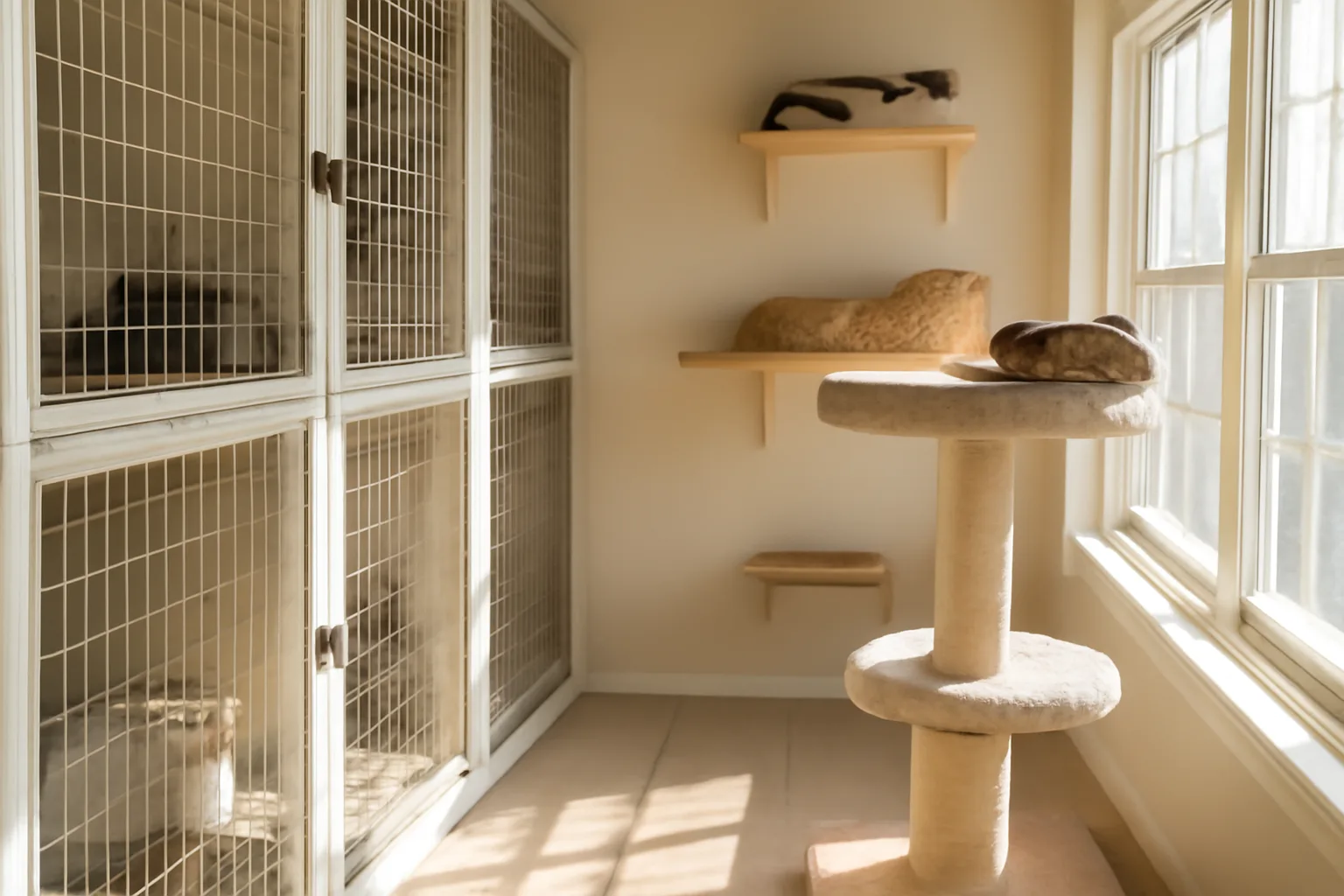
Retrofitting a spare room or building out a basement? Factor in flooring, lighting, drainage, and HVAC upgrades. Connecticut's higher-end contractors can push a modest build-out past $20,000 fast. A do-it-yourself approach with commercial cage banks and washable wall panels can keep you near the $5,000 floor. I have seen one breeder spend $8,000 on a well-planned garage conversion and another spend $25,000 on a climate-controlled shed. Both ended up with functional, compliant spaces.
Ongoing monthly cattery costs in Connecticut
The American Pet Products Association 2023 to 2024 National Pet Owners Survey puts the average annual cost for one cat at $329 for food, $182 for routine vet care, and $175 for litter [8]. For a five-cat cattery, that is $3,430 a year just for those three basics.
Multiply for more cats, add higher utility bills from heating and cooling a dedicated space, cleaning supplies, laundry, and the occasional emergency vet visit, and a realistic monthly budget lands between $400 and $800. That is not a national average. It reflects operating in Connecticut, where vet prices and electricity rates run above the U.S. average. Add a 15% buffer. Budget $600 a month and you can absorb a sudden $800 emergency surgery without panic.
Don't forget the quieter recurring costs: association registration fees (CFA, TICA), show entry fees if you show, and replacement equipment. I tell new breeders to open a separate bank account and deposit $700 a month to see how it feels before the kittens start generating revenue.
Connecticut cattery zoning and local requirements
State law does not zone catteries, but your town does. Most Connecticut municipalities treat a home cattery as a "kennel" or a "home occupation." Call your local zoning office before you spend a dollar on cages. Some towns require a special permit or site plan review. Others will not allow a commercial breeding operation in a residential zone at all.
Rural zones and agricultural districts give you more room. Many breeders locate in Litchfield County or the Quiet Corner for exactly that reason. Even then, you may face setback requirements, noise ordinances, and waste disposal rules. The investment is too big to risk on a guess. Get your zoning determination in writing.
How to apply for a Connecticut cattery license
The application is short. Download the kennel license application from the Department of Agriculture's website [2]. Fill it out, attach a check for $100 payable to "DOAG," and mail it to the address on the form. No notary needed.
The agency then schedules an inspection. During the walkthrough, the inspector checks that your facility meets the sanitation, housing, and recordkeeping standards in the regulations. Pass, and the license arrives by mail. Renewal is an annual form and the $100 fee, without a re-inspection unless a complaint triggers one.
CatteryPath sells a $149 USDA and State Cattery Kit that bundles the pre-filled state form, the federal application, and a readiness checklist. It is a useful shortcut when you want one less administrative chore (full disclosure: that is our product). Free forms are always on the DOAG site if you prefer the manual route.
Federal USDA license cost and who needs it
A USDA Class A breeder license costs $10 to apply, then an annual fee based on gross sales. The current fee table [5] breaks down like this:
| Gross Annual Sales | Annual License Fee |
|---|---|
| Up to $500 | $120 |
| $501 to $2,000 | $215 |
| $2,001 to $5,000 | $350 |
| $5,001 to $10,000 | $560 |
Most small Connecticut catteries sit in the bottom tier. The license is required only if you sell cats sight unseen, online, via a broker, or to a pet store. Retail sales where the buyer and cat are face-to-face on your premises are exempt under the Animal Welfare Act [3].
Pull the USDA trigger if you ever plan to ship a kitten or sell to someone who buys off photos and a phone call. The federal license carries recordkeeping and random inspection obligations, but those overlap with Connecticut's already reasonable requirements.
Local town cattery license fees and inspections
Town kennel license steps are simple: visit the town clerk, fill out a short form, pay a fee. Each town sets its own. Farmington charges $25 [6]. West Hartford charges $50 [7]. Some towns, like Manchester, ask for a rabies vaccination certificate before issuing the license.
Always ask the clerk whether a separate cattery license exists or whether they treat cats under the same kennel license they use for dogs. Most towns do not inspect; they take the state license as proof of compliance. A few, mostly larger cities, may send a health official. The cost is minor. The penalty for skipping it is not. Under state law, towns can fine you per day of violation.
Recordkeeping and inspections for Connecticut catteries
The Department of Agriculture requires records of all cats purchased, acquired, sold, or transferred, along with vaccination certificates and health records [2]. USDA adds more detail: record dates of acquisition, sources, and disposition of every animal, and hold those records at least one year after the animal leaves your facility.
State inspections are complaint-driven or tied to renewal, though renewal inspections are not routine. USDA may inspect randomly at least once a year if you hold a federal license. Keep one binder with all records in a single place, organized by cat. When an inspector calls, hand over the binder and you will likely sail through.
Cattery insurance costs in Connecticut
Connecticut does not require liability insurance for a cattery. I still recommend it. A general liability policy covering bodily injury and property damage can cost $300 to $600 per year through companies like The Hartford or specialty pet business insurers. Umbrella coverage is extra.
The biggest risks are a visitor getting scratched or bitten, or a fire that destroys your facility. If you own your home, your homeowner policy may exclude business-related claims unless you carry a rider. Talk to an agent who knows small animal enterprises. It costs less than a single emergency vet bill.
How Connecticut cattery costs compare to nearby states
Connecticut's $100 annual kennel license sits on the lower end. In Florida, the annual license fee can reach $250 (see cattery cost in Florida). Alabama's fee structure differs; check cattery cost in Alabama. Out west, California's requirements add more layers (see cattery cost in California).
The USDA portion is flat nationally, so the real differences are in state and local fees. For a broader look, we have detailed breakdowns for cattery cost in Arizona, cattery cost in Arkansas, cattery cost in Colorado, cattery cost in Delaware, and cattery cost in Georgia.
What a realistic first-year cattery budget looks like
Here is a sample first-year budget for a small home cattery with two queens and one stud, assuming you already have a suitable room:
| Category | Estimated Cost |
|---|---|
| State + USDA + local licenses | $270 |
| Cages, enclosures, furnishings | $7,500 |
| Quarantine area setup | $750 |
| Litter system & supplies | $600 |
| Initial vet exams & testing | $500 |
| Breeding stock (3 cats) | $6,000 |
| Insurance (first year) | $500 |
| Miscellaneous supplies | $1,500 |
| Total | $17,620 |
That number shifts with your choices. Build luxury enclosures and import a champion bloodline, and you could cross $30,000. Start with older retired breeders and used equipment, and you could stay under $10,000. Plan each line item before you swipe a credit card.
Want all the federal and state paperwork in a single order? Our $149 CatteryPath kit handles it. Otherwise, the DOAG website has the free forms and you can assemble the package yourself.
Frequently asked questions
Do I need a USDA license if I only sell kittens face-to-face from my home?
No. Face-to-face retail sales where the buyer comes to your premises are exempt from the Animal Welfare Act licensing requirement. If you ever ship a kitten or sell to someone you have not met, you need a USDA Class A license. Many breeders get it anyway so they can sell sight unseen without legal risk.
What does the Connecticut state kennel license inspection cover?
The inspector checks that housing is clean, dry, and safe, that ventilation and temperature control are adequate, and that you have a written plan for cleaning and disease control. They also verify that you keep records of vaccination and sales. No surprise lab tests or background checks are involved.
How often does the state re-inspect licensed catteries?
Renewal inspections are not routine. The state typically inspects on complaint or when there is reason to believe standards are not met. USDA license holders may face random annual inspections. Keep your records current and your facility clean, and you will have little to worry about.
Can I run a cattery from a rented apartment in Connecticut?
Almost certainly no. Most leases forbid commercial breeding. Even if the lease allows pets, a cattery business likely violates the use clause. Check with your landlord and your town zoning office. Finding a rental that explicitly permits a cattery is rare.
What health records must I keep for my cats in Connecticut?
You need current vaccination certificates for rabies and panleukopenia, plus records of any vet exams and treatments. USDA licensees also need intake and disposition logs. A simple three-ring binder per cat works, with a copy of each document sorted by date.
Is a cattery considered a business for tax purposes in Connecticut?
Yes. Income from kitten sales is taxable. You may need to register with the Connecticut Department of Revenue Services and collect sales tax if you sell supplies. Consult a CPA who knows small animal enterprises. Some expenses, like feed and facility costs, are deductible.
How much does liability insurance cost for a cattery in Connecticut?
A commercial general liability policy for a small cattery typically costs $300 to $600 per year. Premiums depend on your cat count, whether visitors are allowed on site, and the insurer's appetite for animal risks. The Hartford and a few specialty carriers offer policies built for breeders.
What is the difference between a kennel license and a pet shop license in Connecticut?
A kennel license is for breeding cats on your premises. A pet shop license is for selling animals you acquire from other sources. If you only breed and sell your own kittens, you need the kennel license. If you also resell cats from other breeders, a pet shop license may be required.
Do I need a permit for litter and waste disposal from a cattery?
No special state permit exists, but you must follow local waste rules. Large volumes of used litter may push your household trash into commercial collection territory. Check with your town public works department. Never flush litter; it can damage plumbing and septic systems.
How soon can I start breeding after my license is issued?
You can start as soon as the license is in your hands. Do not sell or advertise kittens until the license is valid. Some breeders wait until after the first state inspection to avoid compliance surprises, but legally the date on the license is what matters.
What are the fines for operating an unlicensed cattery in Connecticut?
Fines vary by violation. Under state law, each day of unlicensed operation can be a separate violation, potentially reaching hundreds of dollars per day. The Department of Agriculture can also seek a court order to shut you down. Local towns may impose additional fines.
Do I need a separate license to sell cats at cat shows in Connecticut?
No state license beyond your kennel license is needed. Show organizers may require proof of current license and health certificates. Your kennel license covers sales made at a show as long as you are the breeder. Bring copies of your license and health records.
Sources
- Connecticut General Statutes § 22-344: Definition of kennel includes cats kept for breeding, requiring a license.
- CT DOAG Animal Breeder & Kennel Program: State kennel license required, annual fee $100, 30-day inspection goal.
- USDA APHIS Retail Pet Store Exemptions: Face-to-face retail sales are exempt from the AWA license requirement.
- Connecticut General Statutes § 22-342: Towns may license dogs and cats and set fees.
- USDA APHIS Animal Welfare Act License Fees (9 CFR 2.6): Class A application fee $10; annual fee $120 for gross sales up to $500, $215 for $501 to $2,000.
- Town of Farmington, CT, Town Clerk License Fees: Kennel license fee $25 for up to 10 animals.
- Town of West Hartford, CT, Town Clerk Dog Licenses: Kennel license fee $50 annually.
- APPA National Pet Owners Survey 2023-2024: Average annual cat expenses: food $329, veterinary $182, litter $175.